
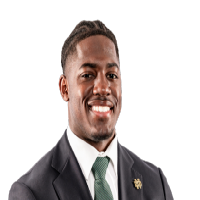
Bottom Line
Round 1 capital (Pick 32) to a Seattle backfield with 221 vacated carries and Charbonnet on IR — Price walks into a near-empty depth chart as the RB3 in this class per the model. Buy as the locked-in RB1 of your rookie draft outside the top 3 picks.
Team Fit & Opportunity
Seattle gutted the RB room and used a first-rounder to replace it. With Charbonnet on IR and only Emanuel Wilson and George Holani behind a questionable Robbie Ouzts, Price has a clearer Week 1 lead-back path than almost any rookie in this class. The 221 vacated carries are real, and Sam Darnold's offense leans on play-action, which rewards a downhill one-cut runner. The 35 vacated targets are modest — receiving usage will be earned, not gifted.
Talent Profile
A 72nd-percentile model grade backed by genuinely strong efficiency: 0.93 RYOE/att and 1.28 BWOE/att against an 87th-percentile schedule means he created when the math said he shouldn't have. The 4.49 forty and 6.9 RAS won't wow anyone, and 59th-percentile athleticism caps the home-run upside, but 1.12 YACoE/att shows the contact balance translates. The red flag in the profile is a 15th-percentile receiving score — this is a two-down profile until proven otherwise, with passing-down work going elsewhere.
Strengths
- Contact-balance creator: 1.28 BWOE/att and 1.12 YACoE/att against 87th-percentile competition — the SEC-equivalent schedule strengthens the signal that the production isn't padded.
- Draft capital lock: Pick 32 to a team that just cleared the depth chart — front offices don't spend first-round picks on committee backs.
- Day-1 path: With Charbonnet on IR and no veteran threat behind him, Price doesn't need an injury or a benching to get 15+ touches; he needs to not fumble.
Concerns
- Receiving profile: 15th-percentile career receiving score is the single biggest dynasty cap — in PPR, this is the difference between RB1 overall and RB15.
- Athleticism ceiling: 59th-percentile athletic profile and 6.9 RAS suggest he wins with vision and balance, not separation or breakaway speed; 0.04 EXPOE/att (basically league-average explosive rate) confirms it.
- WAA at 18th percentile: His Notre Dame production wasn't dominant relative to teammates, which is the one wart on the efficiency story.
Historical Comp Read
Miles Sanders (66% model, 84% similarity) and Elijah Mitchell (69%, 87%) are the instructive comps. Sanders hit RB1 overall seasons when given volume but never sustained — same archetype: efficient, not elite athletically, receiving work came and went. Mitchell flashed as a rookie and injuries erased him. Bhayshul Tuten (2025) is the same-class athletic doppelgänger but lacked the capital. The signal: weekly RB1 ceiling exists, but it's volume-dependent, not talent-forced.
Outlook
Year 1: 220+ carries, 25-30 catches, RB18-24 finish with weekly RB1 spikes when Seattle scripts him 18 touches. Three-year arc: top-12 PPR back if he develops as a receiver and keeps the early-down job through Charbonnet's return. Catalyst is passing-down trust by midseason — that unlocks a true three-down workload. Floor trigger is Charbonnet returning healthy and Seattle reverting to a true committee, capping Price at RB25-30. Treat him as a high-floor RB2 with RB1 weeks baked in.