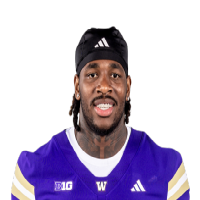
Bottom Line
RB2 in the 2026 class by model (77th percentile) lands in Denver as a Day 3 pick (Round 4, 108) behind RJ Harvey and J.K. Dobbins — a talent/opportunity mismatch that caps year-1 ceiling. Buy at his depressed 2.01 ADP if you're patient; the receiving profile (96th percentile) is the path to relevance.
Team Fit & Opportunity
Denver invested a 2025 second-rounder in RJ Harvey and signed J.K. Dobbins to anchor the room, leaving Coleman as the fourth back on paper ahead of Jaleel McLaughlin and Tyler Badie. The 25 vacated carries / 25 vacated targets reflect a backfield that's already been re-tooled. Sean Payton's scheme historically rewards backs who can pass-protect and catch out of the backfield — exactly Coleman's wheelhouse — but the realistic year-1 role is third-down change-up at best, with goal-line vulturing if his 220-pound frame earns short-yardage trust.
Talent Profile
Coleman is a 5'8"/220 bowling ball whose tape backs the analytical signal: 0.58 career RYOE/att and 0.97 YACoE/att say he creates after contact at a rate few backs in this class match, and the 96th-percentile receiving score is the separator. The 44th-percentile athleticism score and Round 4 capital tell you why he fell — he's not a home-run threat (0.01 EXPOE/att is pedestrian) and lacks the long speed to scare a defense vertically. Production was real against an 84th-percentile schedule. He's a contact-balance, third-down weapon, not a workhorse projection.
Strengths
- Contact balance and short-area power: 0.97 YACoE/att and 0.43 BWOE/att at 220 pounds — he breaks the first tackle and falls forward, a translatable trait for short-yardage and goal-line work.
- Receiving chops: 96th-percentile receiving score makes him a legitimate three-down option in passing situations, the cleanest path to standalone fantasy value behind Harvey/Dobbins.
- Proven against real defenses: 84th-percentile strength of schedule means the efficiency numbers weren't padded against the Pac-12 bottom feeders.
Concerns
- Draft capital ceiling: Round 4, Pick 108 — historically, fourth-round RBs hit RB2 fantasy seasons at single-digit rates, and capital correlates more tightly with opportunity than college production does.
- Depth chart logjam: Harvey is the future, Dobbins was paid to be the present, and McLaughlin already owns the change-of-pace role — Coleman needs two players above him to fail or move.
- Athletic profile: 44th-percentile athleticism and limited explosive-play production (0.01 EXPOE/att) cap the breakaway upside even if volume materializes.
Historical Comp Read
The Josh Jacobs comp (80% similarity) is seductive but misleading — Jacobs went Round 1 with workhorse capital; Coleman didn't. The more honest comps are Trevor Etienne and Jonathon Brooks: similar bowling-ball builds and receiving utility, neither of whom translated college efficiency into fantasy relevance without injury luck or depth chart collapse. The signal here is "useful NFL back, rarely a fantasy starter" unless the situation breaks open.
Outlook
Year 1: RB50-range, sporadic flex weeks if Dobbins misses time, otherwise stashed. Three-year arc hinges entirely on Harvey — if Harvey ascends as expected, Coleman is a career RB3/handcuff; if Harvey disappoints or Dobbins's injury history resurfaces, Coleman's receiving role can scale into RB2 territory in a Payton offense that has historically funneled targets to backs. Catalyst: a Dobbins injury opens passing-down work by midseason. Risk trigger: McLaughlin keeps the third-down role and Coleman is a 2027 cut candidate.